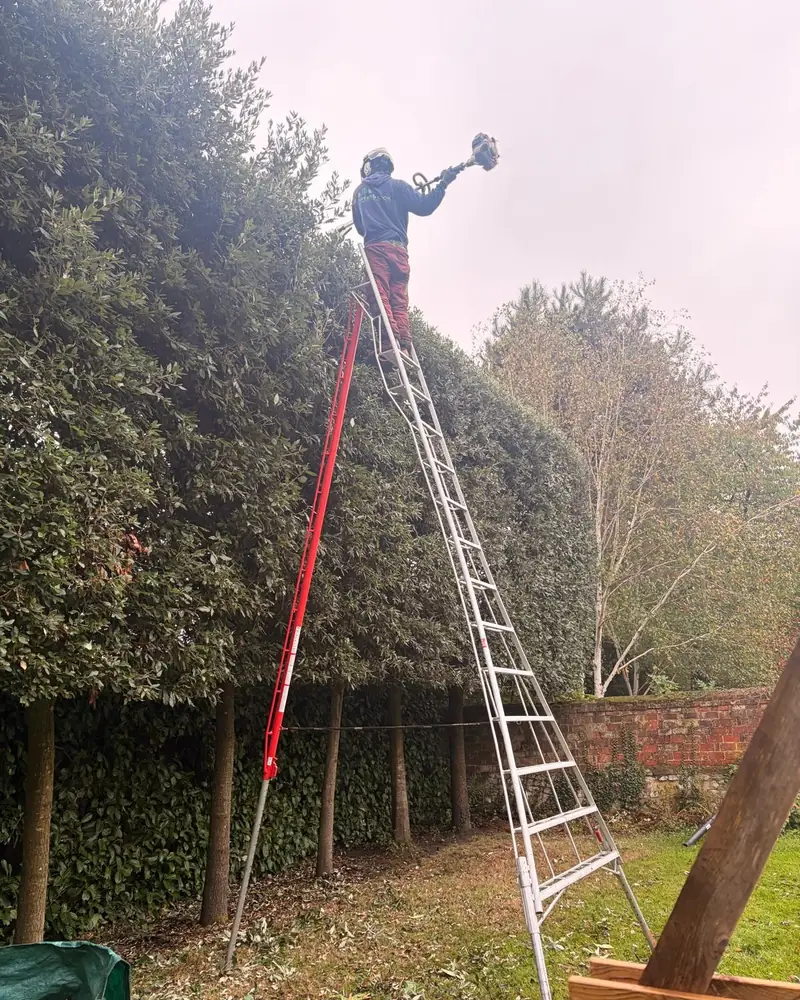
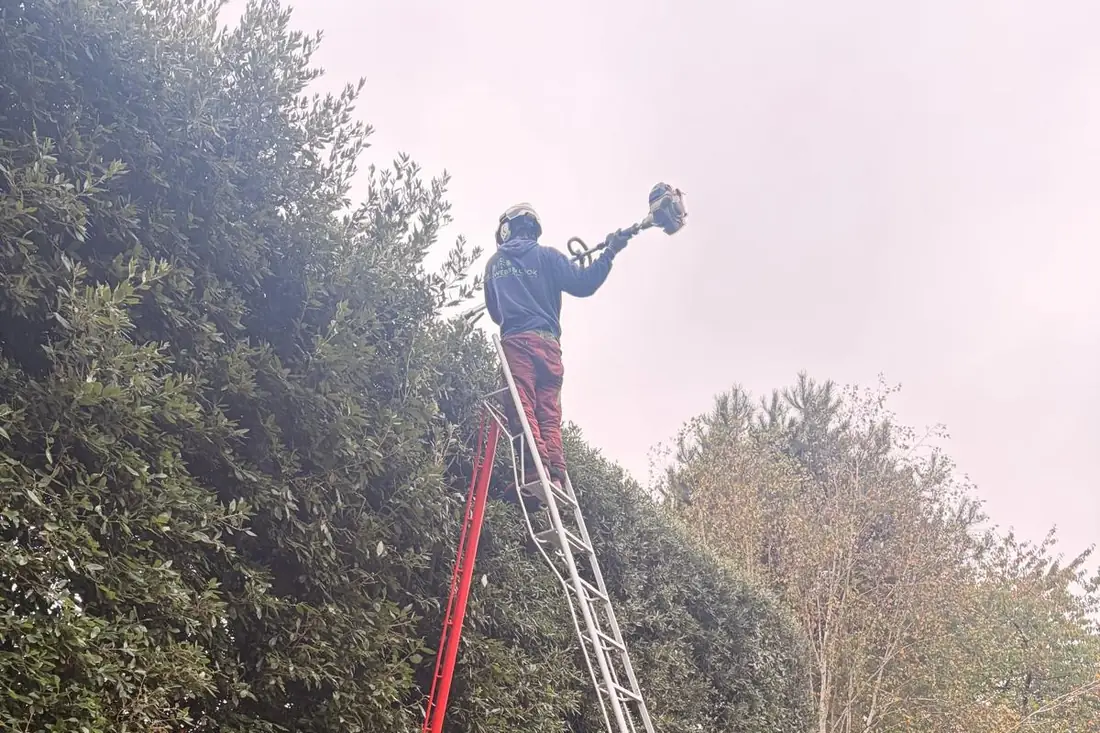
A tapered hedge keeps its base. A top-heavy one shades itself and goes bare.
Which hedges come back
Know where the line is.
How hard a hedge can be cut depends on the species. We’ll tell you where the line is before we start, not after.
Regrows from old wood
Yew
Beech
Hornbeam
Privet
Hawthorn
Western red cedar
Stays brown if cut too hard
Leylandii
Lawson cypress
Keep these trimmed within the green.
From a single roadside hedge to long estate boundaries.
Routine yearly trims, careful restoration of hedges that have been left to grow, and formal and topiary work on shaped specimens. Every job is planned around the site, and every hedge is checked for nesting birds and other wildlife before we cut.
The cuttings are either taken away or chipped on site, and each hedge is finished by hand to a clean, sharp line.
01
Annual maintenance trims
A regular trim keeps a hedge at the size and shape you want. Most garden hedges need it once or twice a year: beech and hornbeam are happy with one cut, privet and Leylandii want two or three to stay tidy.
The detail that matters is the profile. A hedge cut slightly narrower at the top than the bottom lets light reach the base. Cut it with straight sides, or wider at the top, and within a few years the bottom goes thin and bare.
The cuttings are taken away or chipped on site, and every hedge is finished by hand for a clean, sharp line.
02
Restorative reductions
Taking real height and width off a hedge that has got away, usually because it is shading the garden, blocking a window or creeping out over the lawn.
How far you can go depends on the species. Yew, beech, hornbeam, privet and hawthorn regrow from old wood, so they can be cut back hard and will recover. Leylandii and Lawson cypress won’t: anything cut back past the green stays brown, which is why we show you where the line is before we start.
A long-neglected boundary hedge is best brought back over two or three seasons, one side at a time. It keeps the screening while the hedge rebuilds, and it is far kinder to the plants.
03
Formal and topiary work
Shaped specimens, formal lines and clipped features need more care than a boundary hedge. Each cut follows the shape that’s already there, and the finish is done by hand.
Tell us how you’d like a piece kept, and we’ll cut to that each time.
04
Estate and roadside boundaries
From a single roadside hedge to long estate boundaries, cut to suit the site: a tidy line along a road, clear sightlines at a gateway, or a boundary kept thick for screening and wildlife.
Longer runs can be planned so the work, and the cost, is spread sensibly through the year.
05
Wildlife checks
It is an offence to damage or destroy the nest of any wild bird while it is in use or being built. The main nesting season runs from March to August, but a nest is protected whenever it is active.
We cut hedges all year round. Before every job we check the hedge for nesting birds and other wildlife, with particular care from March to August, and if we find an active nest, that section waits.
Questions
Questions we get asked
When is the best time to cut a hedge?
We cut hedges all year round. From March to August we check every hedge for nesting birds first, and if there’s an active nest, that section is left until the birds have gone. Bigger reductions are often easier on a hedge in autumn and winter.
Can my overgrown hedge be cut back hard?
Most broadleaf hedges, and yew, regrow from old wood, so they can be cut back hard and will recover, sometimes over two seasons. Leylandii and Lawson cypress won’t: cut past the green and it stays brown.
What happens to the cuttings?
They’re either taken away or chipped on site, whichever suits you, and the base of the hedge is left clear.
My neighbour’s hedge is far too high. What can I do?
Talking to them first is usually best. If that doesn’t work, councils can deal with complaints about evergreen or semi-evergreen hedges over two metres tall under the high hedges rules, normally for a fee.