Tree consultancy

Advice, surveys and reports.

Surveys, reports and plans to BS 5837:2012 for development, tree safety assessments, and plain advice on protected trees.

Development
Surveys and reports to BS 5837:2012
Safety
Tree condition and risk assessments
Pricing
A tailored quote after a first conversation
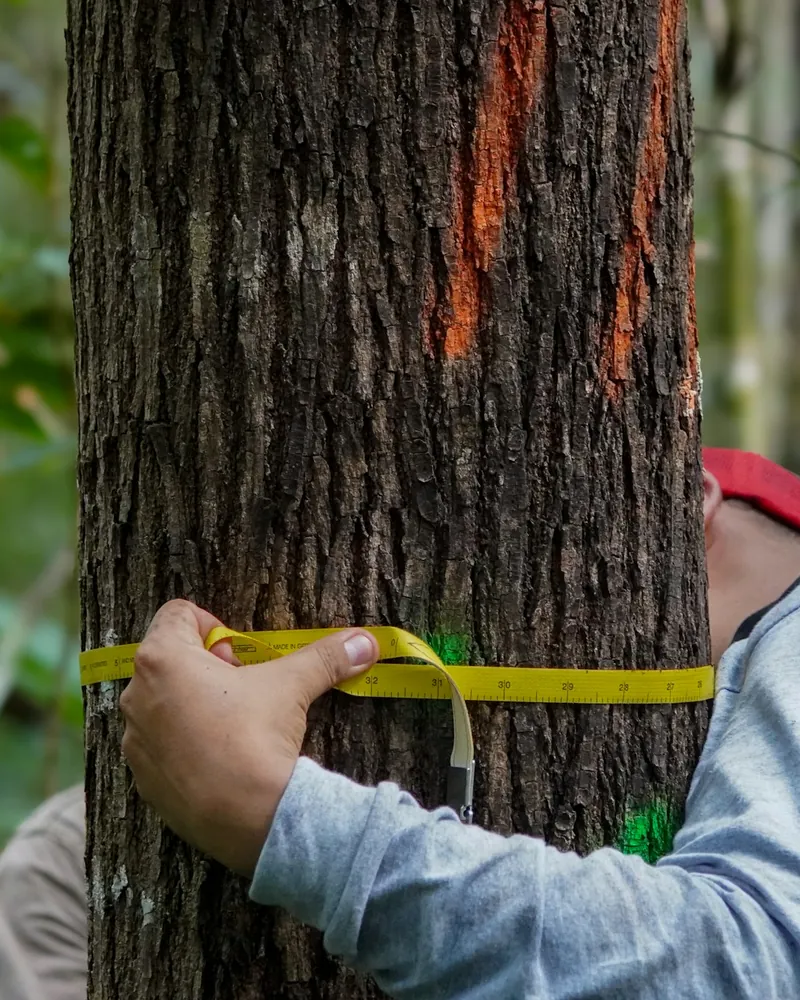
A surveyor holding a tape around a tree trunk to measure its diameter

Advice, surveys and reports, for trees on and around a development and for anyone responsible for trees on their land.

We provide arboricultural advice, tree surveys, reports and plans to support development proposals, from single extensions and new-build homes to larger residential and commercial developments. Surveys and reports follow BS 5837:2012 and current arboricultural best practice.

01

Trees and development: BS 5837:2012

When trees stand on or close to a proposed development, their condition, value and constraints are part of the planning and design process. Councils often ask for arboricultural information showing how the trees will be considered and protected through construction.

We provide tree surveys, reports and plans to support development proposals, from single extensions and new-build homes to larger residential and commercial schemes, in line with BS 5837:2012, Trees in relation to design, demolition and construction, and current best practice.

A survey to BS 5837 records each tree’s species, size and condition, gives it a retention category, and works out its root protection area: the ground around it to be kept clear of digging, storage and machinery.

Getting it done early costs less than getting it done late, because it shapes where you can build.

02

Tree safety assessments and surveys

Tree owners have a responsibility to manage the risks from trees on their land in a reasonable and proportionate way.

A safety assessment is a professional look at the condition of your trees. Any defects or risks are recorded, with suitable remedial work recommended where it’s needed.

It also gives you a dated record that the trees have been inspected by a competent arboricultural specialist, which is worth having even when no work is needed.

Postcode checker

Is your tree protected?

See how far you are from our yard, which council looks after trees where you live, and whether you’re in a conservation area.

Your full postcode gives the most detail. The first half works too. Nothing is stored.

HampshireSurreyBerkshireYour council
  • Ewshot1.8 mi
  • Church Crookham2.2 mi
  • Dogmersfield2.3 mi
  • Odiham3.2 mi
  • Fleet3.3 mi
  • Farnham3.5 mi
  • Winchfield3.8 mi
  • Aldershot4.9 mi
  • Hook5.0 mi
  • Hartley Wintney5.0 mi
  • Tongham6.1 mi
  • Farnborough6.4 mi
  • Ash6.4 mi
  • Alton7.5 mi
  • Yateley7.6 mi
  • Blackwater7.7 mi

How long it takes

Notice periods, side by side.

Plan for these before booking the work. We prepare and submit the notices and applications as part of the job.

Dead treeNotice before work
Five working days
Conservation areaWritten notice
Six weeks
Tree preservation orderCouncil decision
Up to eight weeks
02 wks4 wks6 wks8 wks
01

Tree preservation orders

A tree preservation order is made by the council to protect a tree, a group of trees, an area or a woodland that it considers important to the area. It stays with the land, so it may have been made long before you bought the house.

Without the council’s written consent it’s an offence to cut down, top, lop, uproot, wilfully damage or wilfully destroy a protected tree. That includes pruning and root work.

To get consent you apply to the council with a description of the work and the reasons for it. The council has eight weeks to decide, and can refuse, agree, or agree with conditions such as replacement planting. A refusal can be appealed.

Destroying a protected tree can mean an unlimited fine. Other unauthorised work can be fined up to £2,500, and the council can require a replacement tree.

02

Conservation areas

Trees in a conservation area are protected even without an order, as long as the trunk is more than 75 millimetres across at 1.5 metres above the ground.

Instead of applying for consent, you give the council six weeks’ written notice of the work. In that time the council can let it go ahead or protect the tree with an order. If you hear nothing after six weeks, the work can go ahead within the next two years.

Those six weeks are the most common reason a booked job gets pushed back, and the easiest one to avoid by checking early.

03

Dead and dangerous trees

Work on a protected tree that’s dead is partly exempt, as is work to make a dangerous tree safe. The exemption only covers what’s needed to remove the danger.

You still have to tell the council: five working days’ written notice before work on a dead tree, or as soon as possible afterwards if work had to be done straight away to deal with an immediate danger.

Photograph the tree before anything is done. If a protected tree is removed because it was dead or dangerous, the owner usually has to plant a replacement.

04

Planning permission

If you have full planning permission, trees that have to be removed or pruned to carry it out can be worked on without separate tree consent.

That only covers the trees the permission actually requires, and outline permission doesn’t count. If in doubt, ask the council, or ask us, before anyone starts.

05

Felling licences

Felling a large amount of timber can need a licence from the Forestry Commission, whether or not the trees are protected. The threshold is five cubic metres in a calendar quarter.

Trees in gardens, orchards, churchyards and public open spaces are exempt, so most garden work doesn’t need one. On estates and in woodland it often does, and we’ll tell you if yours is one of those.

06

Nesting birds and bats

It’s an offence to damage or destroy the nest of any wild bird while it’s in use or being built. The main nesting season runs from March to August, but a nest is protected whenever it’s active.

Bats and their roosts are protected all year. Older trees with holes, cracks or loose bark can hold roosts, and if one could be affected, the work has to be assessed first.

We check every tree and hedge before we start. If we find an active nest, the work waits.

07

Neighbours and boundaries

You can usually cut back branches that overhang your side to the boundary line without asking. You can’t go beyond the boundary, and you can’t go onto your neighbour’s land without permission.

If the tree is protected, the same rules apply as for any protected tree: consent or notice first.

The cuttings belong to the tree’s owner, so offer them back. We’re happy to help with that conversation before any work starts.

Pricing

Priced to the project.

Every project is different, so consultancy is priced on the level of support and expertise it needs. We start with a conversation about your project and what it requires, then send a tailored quotation.

Development surveys and safety assessments are two of the key areas we support. If your project needs arboricultural advice or a service that isn’t covered here, get in touch and we’ll talk it through.

Questions

Questions we get asked

Do I need a tree survey for my planning application?

If there are trees on the site, or close enough to be affected, most councils will ask for one. A survey to BS 5837:2012 shows the council which trees matter and how they’ll be protected during the build.

What does a tree safety assessment give me?

A written record of the trees’ condition, any defects or risks found and the work recommended, if any. It’s useful evidence that the trees on your land have been inspected by a competent specialist.

How do I know if my tree has a TPO?

Check the council’s map, or use the postcode checker above, which also checks conservation areas. We confirm with the council before quoting either way.

How long does a TPO application take?

The council has eight weeks to decide. Work in a conservation area needs six weeks’ written notice instead. We prepare and submit both.

How accurate is the postcode checker?

It’s a good guide, not a decision. It uses the centre of your postcode, and conservation areas are checked against the council boundaries published to planning.data.gov.uk. Only East Hampshire and West Berkshire have published their tree preservation orders there so far, so for other councils the council’s own map is the place to check.

Free quotes

Planning work near trees?

Tell us about the site and what you’re planning. We’ll talk it through, then send a tailored quote.

The quickest way: send a photo on WhatsApp